Why we invested in Gigaton
by Carina NamihThe first thing that hits you when you visit a cement plant is the heat - radiating off every surface, a dry, pressing warmth that makes you aware of the scale of what’s burning twenty metres away. An 80 metre kiln of rotating steel processing 3,000 tonnes of material a day.
An operator I met has been reading this kiln for nineteen years. I watched him make four tiny adjustments in the first twenty minutes. “Fuel’s failing to combust properly. Could be the waste material in this batch - it’s got more moisture than the last delivery.” He’d noticed it in a temperature curve that had moved only a few degrees.
His kiln now runs on alternative fuels - shredded tyres, plastic waste, agricultural residue. Every delivery is different. He has to optimise across more variables, with less margin for error, at machine speed, with human reflexes.
Cement, steel, glass. These are the skeleton of modern civilisation. Every building, road, bridge and data centre depends on them. But producing these materials accounts for 37% of global energy use.
Gigaton, based in London, cuts the cost and emissions from these processes. Its self-learning AI takes full autonomous control of industrial plants. Every plant Gigaton operates avoids 30,000 tonnes of CO₂ annually - the equivalent of 11,000 households - while saving $3m in energy costs.
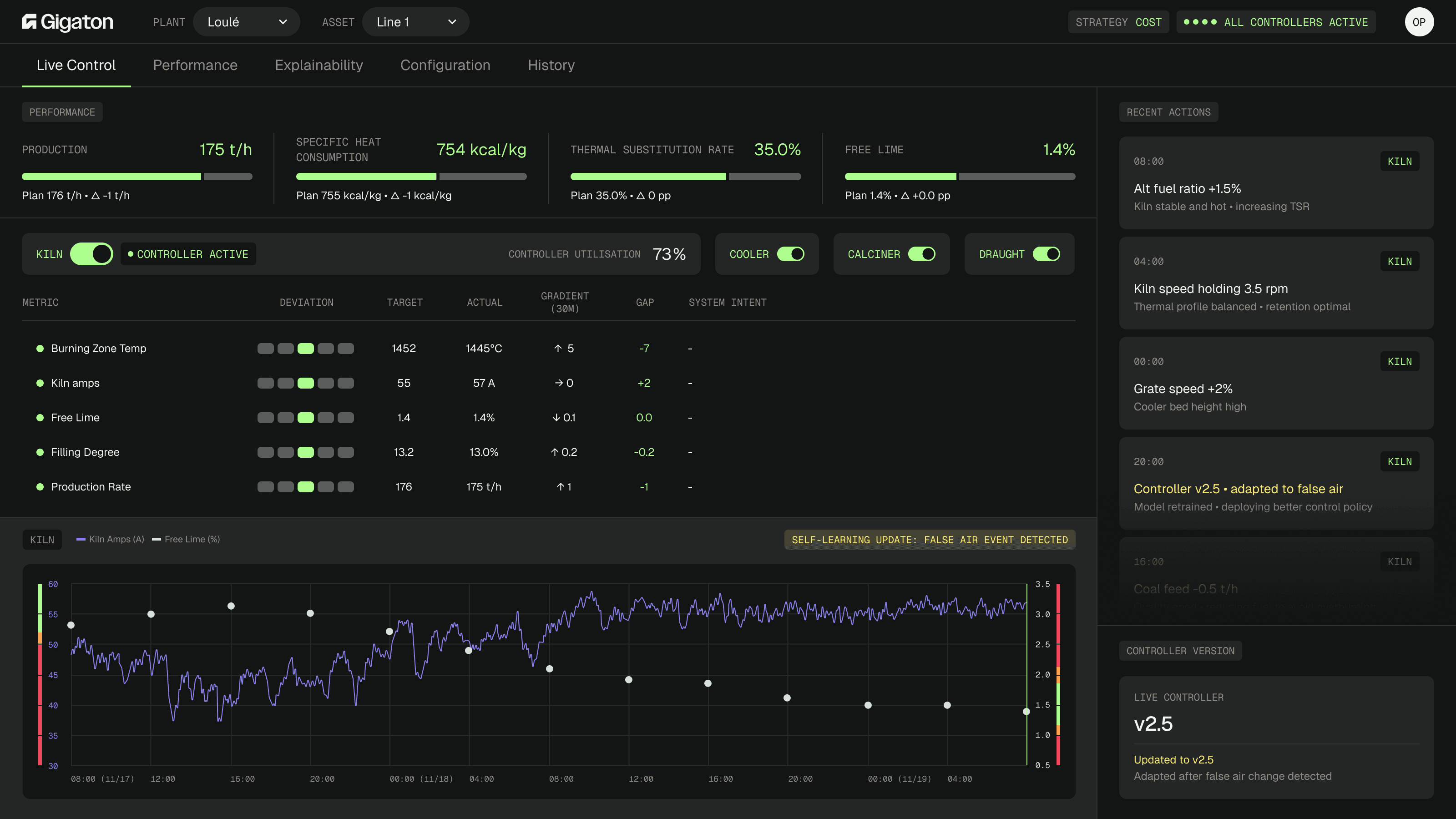
Gigaton's AI simulates process behaviour and forecasts the impact of each action before taking it. It visualises the reasoning behind every decision - operators can see exactly why the AI is adjusting kiln speed or fuel mix in real time. For AI to earn trust in a control room, accuracy isn't enough. Operators need to understand why.
Hard to copy
Five years ago, these plants weren't digitally rich environments. Sensors existed but weren't networked, weren’t standardised, and weren't producing the data streams AI models need. That has changed.
Facilities are now blanketed in sensors generating terabytes of process data. What they lack is an AI layer that can drive.
Deep reinforcement learning is the right tool for this: sequential decision-making under uncertainty, with continuous adaptation to changing conditions. The approach, rooted in research from UCL and Cambridge, is hard to replicate. There are very few people in the world who can do this, and fewer still who combine it with deep operational knowledge of the industries they're applying it to.
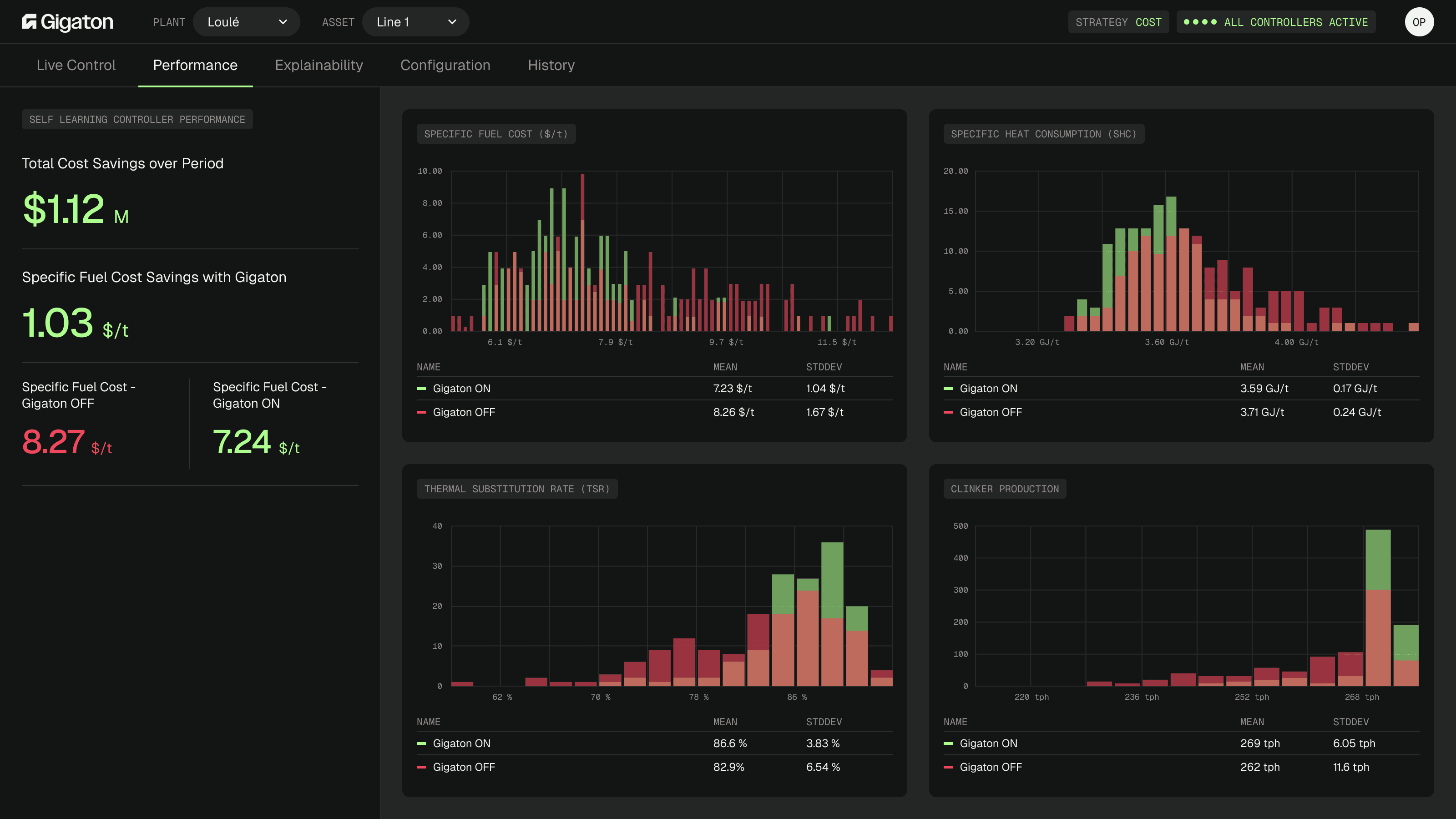
Customers including Heidelberg and Holcim are letting Gigaton's AI run autonomously more than 95% of the time. The Heidelberg deployment delivered a 4% reduction in fuel cost index and a 2% cut in fuel-derived carbon emissions within weeks of going live. On the thin margins of heavy industry, those numbers are significant.
Every deployment feeds back into a central model - each new kiln makes the system smarter for all the others. They already hold the largest cement process dataset outside the producers themselves, and it grows with every new customer.
That fleet-level effect that becomes even more powerful at scale. A company running 40 kilns across 20 countries often has little visibility into why one facility outperforms another. With Gigaton, improvements that work in one plant propagate automatically across the fleet. For a multi-site customer, savings can reach $100m or more.
There are a number of industries like this - essential to our economies and infrastructure, but energy-hungry and under-automated. Gigaton is expanding beyond cement and tackling the likes of glass, steel, paper and mining next.
Frontier AI talent, living on the factory floor
Gigaton was founded as a spinout of Cambridge University and UCL. The scientific foundations - deep RL applied to industrial process control - are world-class. The team could be at a frontier AI lab on a frontier AI salary. Instead, these physicists, ML engineers and process experts are applying their skills to a problem that is urgent, unglamorous, and genuinely hard. Customers get visibly excited when they learn Cambridge AI researchers are optimising their kilns.
Josh Vernon, the CEO, is technical, commercial and mission-driven in equal measure. He led a previous company from founding through to sale in difficult circumstances, and came out with the kind of operational scars we respect at Plural. This matters in an industry where trust is earned slowly and the sales cycle runs through plant managers, not procurement portals.
Why now
The soaring energy demand from data centres is adding a new forcing function - the competition for energy capacity between AI infrastructure and everything else society needs will become ever more acute.
There’s also a competitive pressure that’s only getting sharper - China is already building fully autonomous dark plants - facilities that run without on-site operators. The rest of the world is at risk of falling behind.
A country's ability to produce its own cement, steel and glass at competitive cost is a question of industrial sovereignty. As energy prices grow more volatile and supply chains more contested, the pressure on these industries to operate more efficiently will only intensify.
Meanwhile most AI investment is chasing software businesses with limited defensibility. Gigaton is doing the opposite: applying frontier AI to one of the hardest industries in the world and building a moat that deepens with every deployment.
There are roughly 5,000 cement kilns operating in the world right now. Then steel furnaces. Glass tanks. Paper mills. Each one burning energy, each one under-optimised, each one a potential Gigaton deployment. The physical world runs on these plants. Gigaton is becoming the intelligence that controls them - the operating system for industrial civilisation.